

The Rise of AI Agents in Software Development
In recent months, the rapid development of AI coding agents such as Claude Code, Codex, and other similar tools has triggered revolutionary changes across the software industry.
The future of software development will no longer be primarily based on humans writing code manually. A significant portion of software code will be generated by AI agents, while humans will increasingly focus on higher-level responsibilities such as Product Engineering, business decision-making, architecture, strategy, and quality control.
The primary objective of this new approach is to accelerate product development by 10x, 20x, or even 50x compared to traditional development methods.
Over the next 10 to 20 years, this transformation is expected to fundamentally reshape the entire software industry.
The Nokia Example
There was a time when Nokia was the undisputed leader of the mobile phone market. However, when the smartphone revolution began, the company failed to adapt quickly enough to the new technological era and eventually lost its market leadership.
Today, the software industry is facing a similar turning point.
Companies that fail to transition to AI-agent-driven product development will gradually lose their competitive advantage, fall behind the market, and may eventually disappear.
This transformation is similar to what traditional mobile phone manufacturers experienced during the transition from keypad phones to smartphones.
The Difference Between Manual Coding and AI-Agent-Driven Product Delivery
The difference between traditional software development and AI-agent-driven product development is not limited to the way code is written.
This transformation affects the entire product lifecycle, including:
- ● Analysis
- ● Product design
- ● Requirement development
- ● Architecture
- ● Coding
- ● Testing
- ● Acceptance
- ● CI/CD
- ● Documentation
- ● Continuous development and support
In the traditional model, most of these activities are performed manually by people.
In the AI-Agent-Driven Product Delivery model, the majority of these activities are executed by AI agents, while humans manage the process, provide direction, define constraints, and evaluate the results.
AI-Agent-Driven Product Delivery Consists of Two Main Stages
This new delivery model can be divided into two primary execution stages:
1. Product Requirements Execution with AI Agents
2. Product Development Execution and Delivery with AI Agents
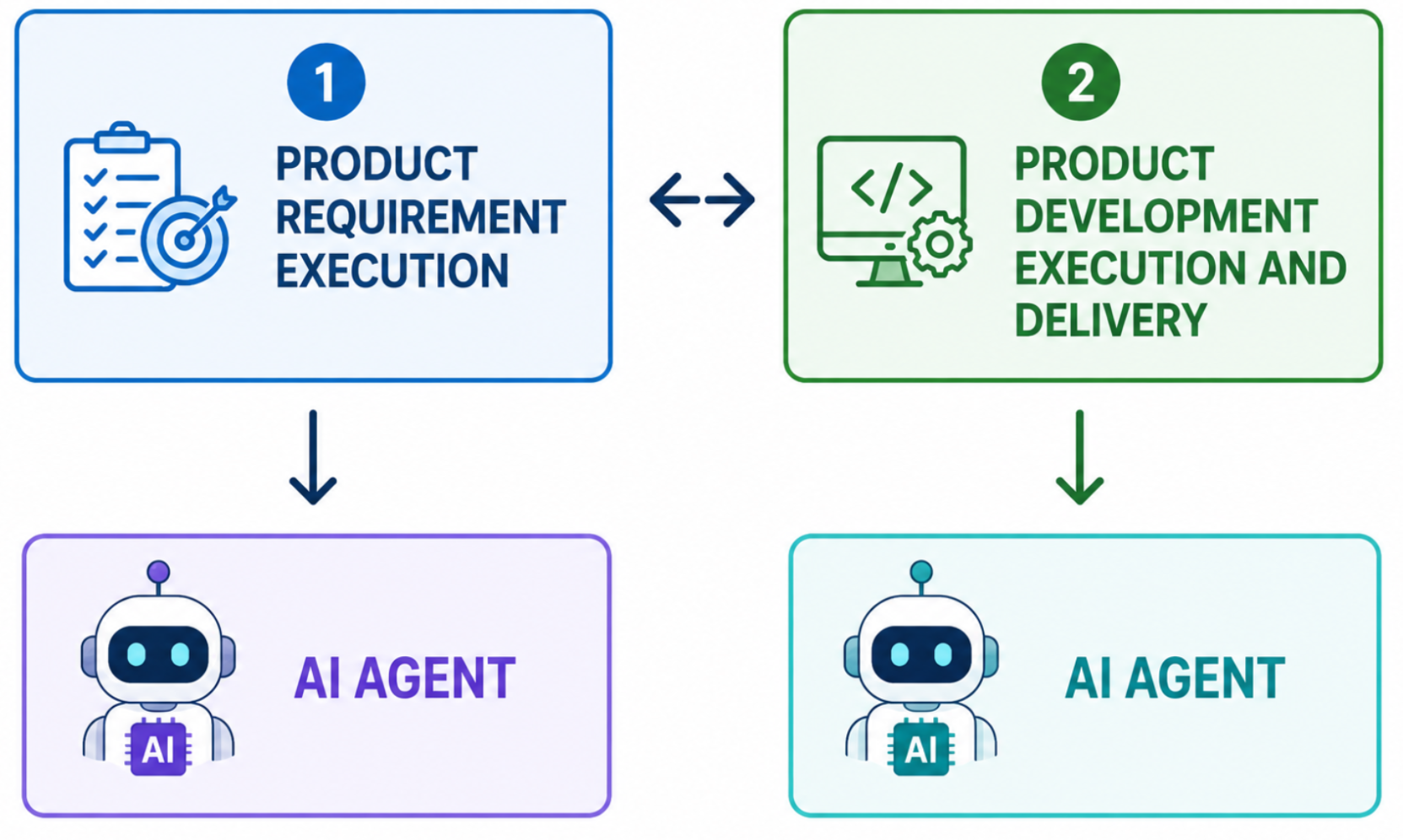
1. Product Requirements Execution with AI Agents
In the first stage, business ideas are transformed into standardized product requirements that AI agents can understand and execute.
Traditionally, this work was performed by Product Managers, Product Owners, Business Analysts, Delivery Managers, and other product-related roles.
In the new era, these professionals will work together with AI agents to create product documentation that is readable, understandable, and executable by AI systems.
2. Product Development Execution and Delivery with AI Agents
The second stage focuses on software development and product delivery.
At this stage, AI Engineers manage and orchestrate AI agents that write, modify, test, refactor, and deliver software into production.
As a result, traditional roles such as Frontend Developer, Backend Developer, Full-Stack Developer, and other classical programming roles will gradually evolve toward AI Engineering and AI Orchestration.
The New Communication Center: The Codebase
In AI-agent-driven product development, Jira tickets, Word documents, and long meetings will no longer serve as the primary communication channels.
Instead, communication will increasingly take place through the codebase located inside Git repositories.
Product requirements will be exported into repositories using standardized formats such as:
-
● Markdown files
-
● JSON files
-
● YAML files
-
● Product Requirement Documents
-
● Architecture documents
-
● RAG knowledge files
-
● Other structured and AI-readable files
These documents will serve as a shared communication language between Product Managers, AI Engineers, and AI agents.
They will no longer remain isolated or inaccessible “black-box” documents. Instead, they will become visualizable, standardized, interconnected, and continuously reusable knowledge assets for AI agents.
A New Wave of Transformation
Just as the smartphone revolution removed thousands of traditional phone manufacturers and related service providers from the market, AI-agent-driven software development will fundamentally transform the software industry.
Many existing roles, processes, tools, and business models will either change completely or become obsolete.
The Current Gap in the Market
Unfortunately, today’s popular project management systems and methodologies were not designed for this new era.
Jira, Trello, and similar tools, as well as Scrum, PMP, PRINCE2, and other traditional frameworks, were primarily created to manage human teams.
They do not adequately support a new Product Delivery model in which AI agents collaborate directly through repositories and codebases.
As a result, a significant gap has emerged in the market from both a methodological and technological perspective.
The Solution Offered by DPS
To address this gap, DPS provides two core components.
Canvas-Driven Product Management
CaPM is a practical guide for creating visual, standardized, and AI-readable Product Requirements for AI-agent-driven product development.
It helps product professionals transform business ideas into structured requirements that can be understood, visualized, documented, and executed by AI agents.
The DPS Platform
The DPS Platform is an AI-native Product Delivery system that automatically transforms Product Requirements into repository structures, RAG files, and standardized documentation that AI agents can use during product development.
As a result, the entire process—from the initial product idea to production delivery—can be executed and managed through AI agents.
In the following video, we will demonstrate through a practical example how the DPS Platform enables AI-agent-driven product development.